

What is SEO Optimization?
THE'’SEO optimization (Search Engine Optimization) is a set of techniques and strategies for improving a website's visibility in organic search engine results. The goal is to drive qualified traffic to your site without paying for each click.
In 2025, with the 68% of online experiences that start from a search engine (BrightEdge), Ignoring SEO means missing out on the most important source of traffic for any online business.
SEO vs. SEM vs. SEA: The Differences
Before continuing, let's clarify some terminology that often causes confusion:
| Term | Meaning | Cost | Time for Results |
|---|---|---|---|
| SEO | Search Engine Optimization – Organic Traffic | Time/resource investment | 3-6 months |
| SEM | Search Engine Marketing – includes SEO + SEA | Variable | Immediate (ads) + medium term (SEO) |
| SEA | Search Engine Advertising – paid ads | Pay-per-click | Immediate |
The fundamental difference? SEO generates "free" traffic once you rank, while with SEA you pay for each click. According to FirstPageSage, companies without SEO spend up to 400% and more in advertising.
Why SEO is Important in 2025-2026
The numbers speak for themselves:
- 91% of marketers confirm that SEO has positively impacted results (Conductor 2025)
- 53.3% of all web traffic comes from organic search
- 75% of users does not go beyond the first page of Google
- 14.6% close rate for SEO leads vs 1.7% for outbound (Intergrowth)
- 702% Average ROI for B2B SaaS SEO Campaigns (FirstPageSage 2025)
Bottom line: If you're not on the first page of Google for keywords in your industry, you're leaving money on the table.
How SEO Optimization Works
To understand how to optimize a website, you must first understand how Google works. The process is divided into three phases: crawling, indexing, and ranking.
The Simplified Process
1. Crawling
Google's "bots" (called Googlebots) navigate the web by following links, discovering new pages and updates. Think of them as explorers mapping the internet.
2. Indexing
Google analyzes the content of discovered pages and stores them in its database (the index). If a page isn't indexed, it won't appear in the results.
3. Ranking (Positioning)
When a user searches for something, Google selects the most relevant pages from its index and ranks them based on hundreds of factors. The goal of SEO is to positively influence these factors.
The Main Ranking Factors
Google uses over 200 factors to determine rankings. Here are the most important ones, grouped by category:
| Category | Key Factors | Estimated Weight |
|---|---|---|
| Content | Quality, relevance, EEAT, freshness | High |
| Backlink | Quantity, quality, relevance of inbound links | High |
| Technique | Speed, mobile-friendly, secure (HTTPS) | Medium-High |
| User Experience | CTR, time on page, bounce rate | Medium |
| On-Page | Title, meta description, H1, structure | Medium |
Realistic Timeline for Results
A frequently asked question: “How long does it take to see results?”
Based on my experience with over 400 projects:
- 1-3 monthsVisible technical improvements, top ranking keywords
- 3-6 months: Steady organic traffic growth, positive ROI
- 6-12 monthsConsolidated results, stable positions
- 12+ months: Built domain authority, composed results
In my case study with Woosa, we have reached +400% organic traffic in just 4 months combining on-page optimization, content refresh, and strategic link building. But it was a case with a solid foundation.
The 4 Areas of SEO Optimization
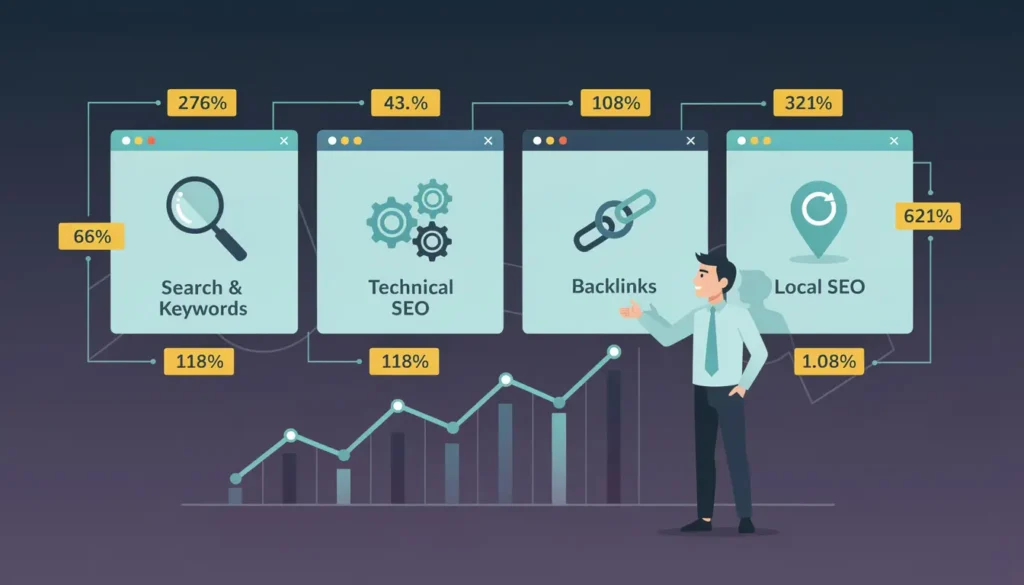
SEO optimization is divided into four macro-areas. Each requires specific attention to achieve comprehensive results.
1. On-Page SEO
There On-Page SEO It concerns everything you can control directly on your pages: content, meta tags, structure, images.
Keyword Research: The Starting Point
Before writing any content, you need to know what your potential customers are looking for. keyword research It is the foundation of every SEO strategy.
Elements to identify:
- Primary keyword: the main term you want to rank for
- Secondary keywords: variations and related terms
- Long-tail keywords: longer and more specific sentences (less volume, more conversions)
- Search intent: what the user really wants (information, purchase, navigation)
Use my free keyword research tool to get started.
Content Optimization
Content is king of SEO. Here's how to optimize it:
SEO Title (Title Tag)
- Include your primary keyword at the beginning
- Keep it under 60 characters
- Make it clickable (use numbers, year, brackets)
Meta Description
- Summarize the content persuasively
- Include keywords naturally
- Add an implicit CTA
- Max 155 characters
Headings (H1, H2, H3)
- Only one H1 per page with primary keyword
- H2 for main sections (use secondary keywords)
- H3 for subsections
- ☐ Primary keyword in the Title Tag (first 60 characters)
- ☐ Persuasive meta description with CTA (max 155 characters)
- ☐ Unique H1 with main keyword
- ☐ Keywords in the first 100 words of the text
- ☐ Short and descriptive URL (e.g. /seo-optimization/)
- ☐ At least 3-5 contextual internal links
- ☐ Images with descriptive alt text
- ☐ Content that fully responds to the search intent
2. Off-Page SEO
There Off-Page SEO It concerns the external signals that tell Google about your site's authority. The main factor? Backlinks.
Link Building: Quality > Quantity
A backlink is a link from another site to yours. Google considers them "votes of confidence." But be careful: not all links have the same value.
Characteristics of a good backlink:
- It comes from an authoritative site (high Domain Rating)
- It is contextually relevant (same industry/topic)
- It is naturally inserted into the content
- It has no “nofollow” attribute (ideally)
How to get quality backlinks:
- Guest posting: write articles for websites in your industry
- Digital PR: create newsworthy content (studies, research, tools)
- Link earning: content so good that it attracts natural links
- Broken link building: Find broken links and propose your content as a replacement
Learn more with my complete guide to link building.
- ☐ Analyze your competitors' backlink profile
- ☐ Identify guest posting opportunities in your industry
- ☐ Remove or disavow toxic backlinks
- ☐ Create linkable content (tools, research, definitive guides)
- ☐ Monitor brand mentions
- ☐ Build relationships with industry influencers
3. Technical SEO
There Technical SEO It ensures that Google can crawl, index, and understand your site without problems. It's the foundation upon which everything else rests.
Core Web Vitals
Since 2021, Google has been using Core Web Vitals as ranking factors. These are three metrics that measure user experience:
| Metrics | What It Measures | Optimal Value |
|---|---|---|
| LCP (Largest Contentful Paint) | Loading speed | < 2.5 seconds |
| INP (Interaction to Next Paint) | Reactivity | < 200 milliseconds |
| CLS (Cumulative Layout Shift) | Visual stability | < 0.1 |
Check your Core Web Vitals on PageSpeed Insights.
Mobile-First Indexing
Google primarily indexes and evaluates the mobile version of your site. If your site isn't optimized for mobile, you're at a disadvantage.
Please verify that:
- The design is responsive
- The buttons should be easily clickable (min 48×48 pixels)
- The text is readable without zoom
- Mobile and desktop content are identical
Schema Markup
Schema markup (structured data) helps Google better understand your content and can generate rich snippets in search results.
Useful schema types:
- Article: for blog posts
- Local Business: for local businesses
- Product: for e-commerce
- FAQ: for frequently asked questions sections
- HowTo: for step-by-step guides
- ☐ Core Web Vitals all “Good” (green)
- ☐ Responsive and mobile-friendly site
- ☐ HTTPS enabled on all pages
- ☐ XML Sitemap updated and submitted to Google Search Console
- ☐ Robots.txt configured correctly
- ☐ No 404 errors on important pages
- ☐ 301 redirect for changed URLs
- ☐ Schema markup implemented
- ☐ No duplicate content (or canonicals set)
4. Local SEO

There Local SEO It is essential for businesses with a physical presence or that serve specific geographic areas. According to Google, the 46% of searches has local intent.
Google Business Profile
Your Google Business profile (formerly Google My Business) is the cornerstone of local SEO:
- Fill in every field in your profile
- Add quality photos regularly
- Reply to all reviews
- Publish weekly posts
- Keep your schedule and information always up to date
Reviews
Reviews influence both local rankings and purchasing decisions. According to BrightLocal 2024, the 71% Consumers do not consider businesses with ratings below 3 stars.
Learn more with my Local SEO case study.
- ☐ Complete and verified Google Business Profile
- ☐ Consistent NAP across all directories
- ☐ At least 20+ reviews with ratings > 4.0
- ☐ Correct business categories selected
- ☐ Local pages on the site (e.g. “SEO St. Gallen”)
- ☐ LocalBusiness schema implemented
- ☐ Local keywords in content (city, neighborhood, region)
SEO Optimization Tools
You don't need a huge budget to do SEO. Here are the essential tools, organized by category.
Free Tools
| Instrument | Use | Link |
|---|---|---|
| Google Search Console | Performance, error, and indexing monitoring | search.google.com |
| Google Analytics 4 | Traffic and user behavior analysis | analytics.google.com |
| PageSpeed Insights | Speed Test and Core Web Vitals | pagespeed.web.dev |
| Screaming Frog (free) | Technical Audit (up to 500 URLs) | screamingfrog.co.uk |
| Keyword Tool Adrian | Italian keyword research | adriangram.ch/keyword-tool |
Premium Tools
| Instrument | Use | Price from |
|---|---|---|
| Ahrefs | Backlink analysis, keyword research, competitors | $99/month |
| SEMrush | Complete SEO + ads + social suite | $119/month |
| SEO Surfer | On-page content optimization | $69/month |
| Screaming Frog (pro) | Complete technical audit | £199/year |
My recommended stack to get you started:
- Google Search Console (free, required)
- Google Analytics 4 (free, mandatory)
- Ahrefs or SEMrush (choose one)
- Screaming Frog free for periodic audits
Common SEO Optimization Mistakes
After 9 years in the industry and 400+ projects, these are the mistakes I see most often:
1. Ignoring Search Intent
Optimizing for a keyword without understanding what the user actually wants. If you search for "SEO optimization" and only offer a services page, you won't be addressing the informational intent of the query.
SolutionAnalyze the top 10 results on Google. What do they offer? Guides? Lists? Videos? That's the intent you need to fulfill.
2. Keyword Cannibalization
Creating multiple pages competing for the same keyword, confusing Google on which one to rank.
SolutionOne primary keyword = one page. Read my complete guide on SEO cannibalization.
3. Thin or Duplicate Content
Pages with little content or copied from other sites. Google penalizes both.
Solution: Create original, in-depth content that adds real value.
4. Neglecting Technical SEO
The best content in the world won't rank if Google can't crawl it or if the site is painfully slow.
Solution: Quarterly technical audit with Screaming Frog or similar.
5. Expect Immediate Results
SEO is a marathon, not a sprint. Anyone who promises "first page in 30 days" is either lying or using risky techniques.
SolutionPlan for 6-12 months. Compound results will arrive.
6. Buying Low-Quality Links
PBNs, link farms, and bulk link exchanges. Google has gotten very good at spotting them.
Solution: A few high-quality links beat hundreds of spammy links.
7. Not Updating Content
A 2020 article with outdated data loses rankings. Google rewards freshness.
Solution: Quarterly content refresh for core content.
How Much Does SEO Optimization Cost?
One of the most frequently asked questions. The honest answer: it depends.
Indicative Price Ranges
| Type of Service | Price Range | Ideal For |
|---|---|---|
| Junior Freelancer | 500-1,500 CHF/month | Small local businesses |
| Senior Freelancer | 1,500-3,500 CHF/month | SMEs, small e-commerce |
| Agency | 3,000-10,000+ CHF/month | Structured companies, complex projects |
| In-house | 60,000-120,000 CHF/year | Large companies with volume |
Expected ROI
According to FirstPageSage 2025:
- B2B SaaS: ROI 702% with break-even in 7 months
- Real Estate: ROI 1.389%
- Financial Services: ROI 1.031%
- E-commerce: ROI 317% with break-even in 9 months
Positive ROI is typically achieved between 6 and 12 months.
I offer a professional SEO audit with personalized intervention priorities for your business.
SEO Optimization in 2026: GEO, AEO, and AI Search
The SEO landscape is changing faster than ever. According to Gartner, traditional search volume could decline by 2026. 25%. Those who don't adapt risk becoming invisible.
The Impact of AI Overviews
The numbers for 2025 are unequivocal:
| Metrics | Value | Source |
|---|---|---|
| Zero-click searches | 60% | SparkToro 2025 |
| Query with AI Overview | 15.69% | Semrush, Nov 2025 |
| CTR Drop with AI Overview | -61% | Seer Interactive 2025 |
| Click on link in AI Overview | Only 1% | Pew Research 2025 |
| AI Users Overviews/Month | 1.5 billion | Q1 2025 |
| AI referral traffic growth | +357% YoY | Jasper 2025 |
The good news? Google still sends 345 times more traffic compared to ChatGPT, Gemini, and Perplexity combined (Ahrefs 2025). Traditional SEO isn't dead, but it needs to evolve.
SEO vs. AEO vs. GEO: The Differences

With the explosion of AI Search, new acronyms have emerged that create confusion. Let's clarify:
| I wait | SEO | AEO | GEO |
|---|---|---|---|
| Meaning | Search Engine Optimization | Answer Engine Optimization | Generative Engine Optimization |
| Objective | Rank in the SERPs | Appear in direct replies | Getting cited by AI |
| Target | Google, Bing (organic) | Snippets, AI Overviews, Voice | ChatGPT, Perplexity, Claude |
| Key metrics | Position, CTR, Traffic | Snippet wins, Zero-click | AI Quotes, Brand Mentions |
| Content Focus | Keyword + intent | Direct answers + structure | Authoritativeness + completeness |
In summary:
- SEO = get found in traditional search results
- AEO = become THE answer (snippet, voice, AI Overview)
- GEO = be cited as an authoritative source by AI
What is AEO (Answer Engine Optimization)?
THE'’Answer Engine Optimization is the practice of optimizing content to appear as a direct response in:
- Featured Snippets of Google (the “position zero”)
- People Also Ask boxes
- AI Overviews by Google
- Voice responses (Siri, Alexa, Google Assistant)
- Bing Copilot
How to optimize for AEO:
- Answer the question in the first 40-60 words
- Use clear formatting (lists, tables, steps)
- Implement FAQ and HowTo schema
- Structure with real questions like H2/H3
What is GEO (Generative Engine Optimization)?
There Generative Engine Optimization is optimized to be cited as a source in AI-generated responses like ChatGPT, Perplexity, Claude, and Gemini.
Unlike AEO (which extracts answers), GEO is about how AI they synthesize information from multiple sources to create original answers.
The key fact: According to Conductor 2025, AI referral traffic already represents the’1.08% of the total traffic of the sites analyzed, with an average growth of’1% month on month. It may seem like a small thing, but two years ago this channel didn't exist.
How to optimize for GEO:
- Create comprehensive content that covers a topic in 360°
- Include original data, research, case studies
- Build authority with backlinks and mentions
- Maintain brand consistency across all platforms
- Implement the file llms.txt (the emerging standard for communicating with AI crawlers)
Triple-Threat Strategy: SEO + AEO + GEO
You don't have to choose between SEO, AEO, and GEO. The winning strategy combines them all:
1. Solid SEO Foundation
- Keyword research and on-page optimization
- Impeccable technical structure
- Quality link building
2. AEO-Ready Structure
- Direct answers at the beginning of each section
- FAQ scheme implemented
- Content formatted for extraction (tables, lists, definitions)
3. GEO authority
- Demonstrable EEAT (author box, credentials, case studies)
- Comprehensive topic coverage (topical authority)
- Multi-platform presence (YouTube, LinkedIn, Reddit)
- Proprietary data and original research
- ☐ Direct answers in the first 50 words of each H2 section
- ☐ FAQ schema implemented with 5+ real questions
- ☐ HowTo diagram for step-by-step guides
- ☐ Author box with verifiable credentials
- ☐ Data with sources cited (year + source name)
- ☐ Content that covers the entire topic (no thin content)
- ☐ Presence on at least 2-3 platforms in addition to the website
- ☐ Configured llms.txt file (optional but recommended)
- ☐ Consistent brand naming throughout
The Future: What to Expect in 2026

Based on 2025 trends and expert forecasts:
- AI Overviews will become the norm – From 15% to potentially 30-40% of queries
- Zero-click will continue to grow – The value will be in the “visibility” rather than in the click
- EEAT will be non-negotiable – AIs will only cite authoritative sources
- Entity SEO will surpass Keyword SEO – Google and AI think in terms of entities, not just keywords
- Multi-platform will be mandatory – YouTube, Reddit, LinkedIn will influence AI citations
I will go into more detail about all this in my guide dedicated to GEO – Generative Engine Optimization, coming in the next few weeks.
Conclusion
THE'’SEO optimization It remains one of the most effective marketing strategies with the highest ROI, even in the AI era. But it requires a comprehensive approach that covers all four areas: on-page, off-page, technical, and local.
The 3 key points to remember:
- SEO is a marathonPlan ahead 6-12 months, don't expect miracles in 30 days.
- Quality > quantity: in-depth content, authoritative links, excellent user experience
- Adapt to AI: EEAT, quotable content, channel diversification
★★★★★
400+ projects completed • Average ROI 702% • Break-even in 6-9 months
🔍 Want to Know How Much Your Website Costs?
Free SEO audit with priority intervention and personalized quote
📧 info@adriangram.ch • Response guaranteed within 24 hours
FAQs
How long does it take to see results from SEO?
The first results of SEO optimization are typically seen between 3 and 6 months. Positive ROI is usually achieved between 6 and 12 months. Projects with a good existing foundation can see faster results, as in my case study with +400% of traffic in 4 months.
Can I do SEO myself or do I need a professional?
You can start on your own with the basics: Google Search Console, quality content, and on-page optimization. For advanced strategies, link building, and complex technical SEO, a professional will accelerate results and avoid costly mistakes. It all depends on your time, budget, and project complexity.
Does SEO still work with Google's AI Overviews?
Yes, SEO still works, but it's evolving. AI Overviews appear in 15-16% of queries and reduce clicks, but 53% of web traffic still comes from organic search. The key is to optimize for mention in AI (GEO) responses as well as for traditional rankings.
What is the difference between On-Page and Off-Page SEO?
On-page SEO involves optimizing elements of your site: content, meta tags, structure, and speed. Off-page SEO focuses on external signals: backlinks, brand mentions, and authority. Both are essential for complete results.
How much does a professional SEO optimization service cost?
Costs vary based on complexity: freelancers 500-3,500 CHF/month, agencies 3,000-10,000+ CHF/month. The average ROI for B2B SaaS is 702% according to FirstPageSage 2025. The investment typically pays for itself in 6-12 months with consistent organic traffic.