

In 2026, SEO professionals' 86% uses artificial intelligence For keyword research. If you're still using only traditional methods, you're leaving opportunities (and traffic) on the table.
Keyword research has changed radically: it is no longer about finding exact words to insert into the contents, but about understand search intent and create content that truly answers users' questions.
In this comprehensive guide I will show you the exact process I use with my clients, the most effective free and paid tools, and give you 5 ready-to-use AI prompts To speed up your search. Finally, you can download my work template to organize everything.
Let's get started.
What Is Keyword Research (and Why It Has Changed)
From Keyword Matching to Semantic Intent
Until a few years ago, keyword research was simple: you found the exact words users were searching for and included them in your content. The more times the keyword appeared, the better.
It doesn't work like that anymore. Google uses advanced AI algorithms like BERT and MUM which include the meaning Behind the searches, not just the words. This means that:
- A page can rank for hundreds of related keywords, not just the main one
- Intent (user intention) matters more than the exact keyword
- Keyword stuffing is penalized, not rewarded
- Topic clusters have replaced single keywords as the strategic unit
Why Keyword Research Is Still Important
Despite the changes, keyword research remains the first step of any SEO strategy. Here's why:
- It's your compass: tells you where to go and if you're making progress
- It makes you understand the audience: Find out what your potential customers are searching for and with which words
- Guide content creation: you know exactly what topics to cover
- Drive traffic that converts: you attract people who are looking for exactly what you offer
The 4 Types of Search Intent (The Foundation of Everything)

Before you search for any keyword, you need to understand the concept of search intent (search intent). It's the "why" behind every Google search.
1. Informational Intent
The user wants learn something. He's not ready to buy, he's doing research.
Typical patterns: “how to”, “what it means”, “why”, “guide”, “tutorial”, “what is it”
Examples: “"How to do keyword research," "What is SEO?", "Why isn't my site indexed?"”
2. Commercial Intent
The user is evaluating options Before buying, compare, read reviews, and find the "best" option.
Typical patterns: “best”, “comparison”, “vs”, “review”, “alternatives to”, “top 10”
Examples: “Ahrefs vs SEMrush”, “best SEO tools 2025”, “Ubersuggest review”
3. Transactional Intent
The user is ready to act: buy, sign up, download.
Typical patterns: “buy”, “price”, “discount”, “offer”, “quote”, “download”
Examples: “SEMrush pricing,” “SEO consulting quote,” “Ahrefs free trial”
4. Navigational Intent
The user is looking for a specific site or page. He already knows where he wants to go.
Typical patterns: brand names, “login”, “access”, “contacts”, specific product names
Examples: “Ahrefs login”, “Google Search Console”, “Adrian Gramada SEO”
Search Intent Summary Table:
| Intent | The user wants… | Pattern | Ideal content |
|---|---|---|---|
| Informational | Learn | how, what, why, guide | Blog posts, guides, tutorials |
| Commercial | Evaluate options | best vs review | Comparisons, reviews, lists |
| Transactional | Buy/Act | buy, price, offer | Landing pages, product pages |
| Navigational | Find a site | brand, login, site name | Homepage, brand pages |
Keyword Types: Quick Ranking
By Length
Short-tail (1-2 words): High search volume, very high competition. Examples: "SEO," "marketing." Difficult to win for new sites.
Long-tail (4+ words): Lower volume, but less competition and a higher conversion rate. Example: "How to do free SEO keyword research." Ideal for beginners.
For Duration
Evergreen: Always relevant over time. "How to do keyword research" will still be effective in 5 years (with updates). They build steady traffic.
Trending: Temporary spikes tied to events, new developments, and seasonality. These are useful for riding the wave, but they don't build long-term traffic.
For Targeting
Geo-targeting: Includes location. "SEO Consultant Milan," "Web Agency Turin." Essentials for local SEO.
Product-defining: Product/brand specifications. "Adrian Gramada SEO Course." Those looking for them are often ready to buy.
LSI Keywords and Semantics
The LSI (Latent Semantic Indexing) keywords are thematically related words to your main keyword. If you write about "keyword research," LSIs might be "search volume," "keyword difficulty," "search intent," or "SEO tools." Google uses them to understand what your content is really about. In 2025, with topic clusters, these keywords are essential for building thematic authority.
Keyword Research Tools
Free Tools
Google Search Console (The Best Free One)
Many underestimate GSC for keyword research, but it is a gold mine. It shows you the actual keywords for which your site is already receiving impressions and clicks.
How to use it:
- Go to Performance → Search Results
- Look at queries with high impressions but low CTR → optimization opportunities
- Search keywords in position 5-20 → with little effort you can bring them into the top 3
- Identify new keywords you hadn't considered
Google Trends
Perfect for analyzing trends, seasonality, and comparing keywords. It shows you whether a keyword is growing or declining, as well as emerging related searches.
Google Autocomplete + People Also Ask
A very powerful free technique: Start typing your keyword into Google and see the suggestions. Then scroll down to "People also asked" to find real questions from users. These are keywords: validated by Google itself.
AnswerThePublic (free version)
Displays user questions graphically. The free version has daily limits but is great for initial brainstorming.
Free AI Tools for Keyword Research
In 2025, AI tools have become essential allies. They do not replace traditional SEO tools, but rather complement them. they complement each other perfectly for brainstorming and organization.
ChatGPT for Keyword Research
ChatGPT excels at generating ideas, variations, and organizing keywords by intent. Later, I'll give you five ready-to-use prompts.
Limitations: Lacks real volume data, doesn't know keyword difficulty, can "invent" non-existent keywords. Always check with SEO tools.
Google Gemini
Similar to ChatGPT but integrated with the Google ecosystem. Useful for searches with more up-to-date sources and data.
Perplexity AI
Ideal for citation searches. Shows information sources, useful for validating keywords and finding industry data.
Paid Tools
Ahrefs
My main instrument. Keyword Explorer provides comprehensive data: volume, difficulty, estimated clicks, related keywords. The function Content Gap It shows you keywords that your competitors rank for but you don't. It's a significant investment, but it's worth every penny for serious SEO.
SEMrush
Complete alternative to Ahrefs. The Keyword Magic Tool It's excellent for expanding seed keywords. It also has a built-in cannibalization report. The interface is more complex, but the features are vast.
Ubersuggest
A cheaper option with a limited free version. Ideal for freelancers and small businesses that can't afford Ahrefs/SEMrush. Less comprehensive data, but enough to get started.
Tool Comparison:
| Instrument | Price | Pro | Ideal for |
|---|---|---|---|
| Google Search Console | Free | Real Google data, current keywords | All (required) |
| ChatGPT/Gemini | Free/€20 | Brainstorming, clustering, variations | All (complement) |
| Ubersuggest | €29/month | Economical, easy to use | Freelancers, small businesses |
| Ahrefs | €99/month | Accurate data, Content Gap, backlinks | Professionals, agencies |
| SEMrush | €129/month | Complete suite, advanced reporting | Agencies, enterprises |
How to Do Keyword Research (Step-by-Step Process)

Step 1: Define the Main Topics (Seed Keywords)
It starts with a brainstorming of the main themes related to your business. Don't think about specific keywords yet, think about macro-topics.
Example for an SEO consultant: SEO, keyword research, link building, on-page optimization, local SEO, technical SEO, content marketing.
Goal: Create a list of 10-20 seed keywords to expand.
Step 2: Expand with Tools
Enter each seed keyword into your tools (Ahrefs, SEMrush, or even just Google Autocomplete) and collect:
- Related keywords suggested by the tool
- Questions (“how”, “what”, “why”)
- Competitors' keywords (Content Gap)
- Long-tail variants
Objective: a rough list of 100-500 keywords.
Step 3: Analyze Search Intent
For each keyword, ask yourself: “What does the user really want when they search for this?”
The best way to figure it out: search for the keyword on Google and look at the top 10 results. Google is already telling you what intent that keyword fulfills.
If the results are all guides and tutorials, the intent is informational. If they are product pages and prices, the intent is transactional.
Step 4: Evaluate Difficulties and Opportunities
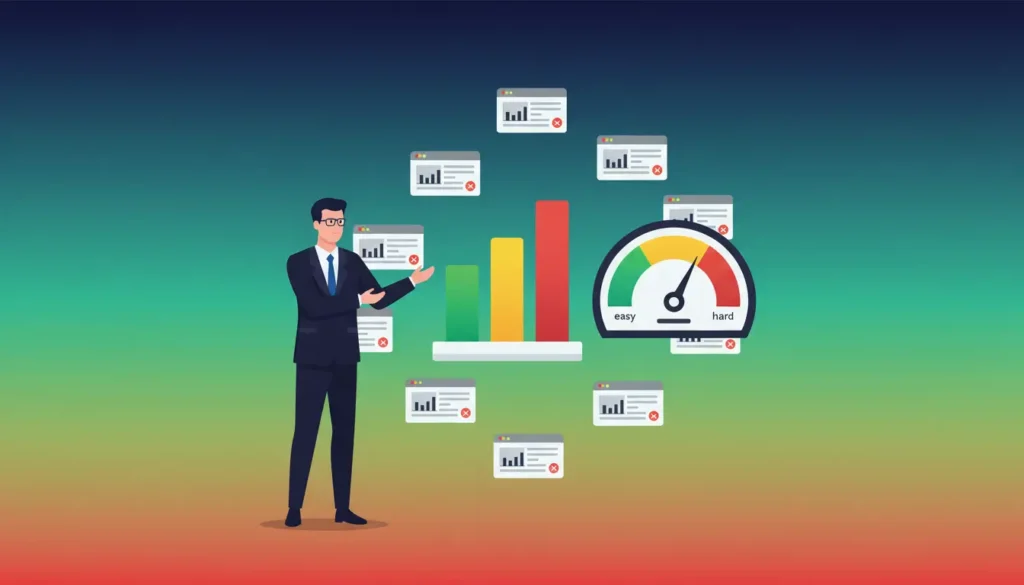
Not all keywords are worth the effort. Consider:
- Search volume: How many people search for this keyword?
- Keyword Difficulty (KD): How difficult is it to rank? (given by Ahrefs/SEMrush)
- Competitor in SERP: Who's ranking now? Are these huge sites, or can you compete?
- Conversion Potential: Does this keyword bring customers or just curious people?
Sweet spot: keywords with decent volume (100-1000/month), low-medium KD (<40), and high conversion potential.
Step 5: Group into Topic Clusters
In 2025, we no longer think about single keywords but about thematic clusters. A cluster is made up of:
- Pillar page: main and complete content on the topic (e.g.: “Complete Guide to SEO”)
- Cluster articles: Support articles on specific subtopics (e.g., “What is keyword research?”, “How to do link building”)
- Internal linking: all cluster articles link to the pillar page
This structure builds thematic authority, signaling to Google that you are an expert on the topic.
Step 6: Map Keywords to Content
Fundamental rule: 1 main keyword = 1 page. If you assign the same keyword to multiple pages, you create cannibalization and the pages compete with each other.
In your template, create a clear map: URL | Primary keyword | Secondary keywords | Intent | Status
Step 7: Analyze SERP Features

Before creating content, look at what Google shows for that keyword:
- AI Overview: if present, consider that it could “steal” clicks
- Featured Snippet: zero position opportunity!
- People Also Ask: questions to include in the content
- Video carousel: maybe it's worth creating a video?
How to Use AI for Keyword Research: 5 Ready-Made Prompts
Here are 5 prompts you can copy and paste directly into ChatGPT or Gemini. Customize the parts in [brackets].
📝 Prompt 1: Brainstorming Seed Keywords
📝 Prompt 2: Long-tail expansion
– Questions (how, what, why)
– Keywords with commercial intent (best, comparison, review)
– Keywords with transactional intent (price, buy, quote)
📝 Prompt 3: Search Intent Analysis
[paste keyword list]
📝 Prompt 4: Creating a Topic Cluster
– 1 main pillar page with its target keyword
– 8-10 supporting cluster articles with related long-tail keywords
– How to connect articles to each other with internal linking
📝 Prompt 5: Content Gap Analysis
⚠️ AI Limitations: AI doesn't have real volume data, doesn't know keyword difficulty, and can suggest keywords that no one searches for. Use these prompts for brainstorming and organization, then always check with SEO tools (GSC, Ahrefs, SEMrush).
Keyword Research Template (Free Download)
To make everything easier, I created a template that I personally use in my projects. It includes:
- Seed Sheet Keywords: for the initial brainstorming
- Expanded Keyword Sheet: with columns for volume, KD, CPC
- Intent Analysis Sheet: classification by intent type
- Topic Cluster Sheet: pillar + cluster organization
- Keyword Mapping Sheet: keyword assignment → URL
- Prioritization Sheet: scoring to decide where to start
📥 DOWNLOAD THE FREE TEMPLATE
Enter your email address in the form to receive the template and updates on my SEO guides.
Common Mistakes in Keyword Research
1. Obsession with Volume
High volume ≠ better keyword. A keyword with 10,000 searches/month but impossible competition and generic intent is worse than one with 200 searches/month that converts. Better 100 visits that buy than 10,000 that bounce.
2. Ignoring Search Intent
Creating an informational guide for a transactional keyword (or vice versa) means zero chance of ranking. Always check the SERP before writing.
3. Don't Consider the Difficulty
A new site can't compete for SEO (KD 90+). Start with long-tail keywords with low KD, build authority, then scale up to more competitive keywords.
4. Keyword Stuffing
Repeating the same keyword 50 times no longer works. Google penalizes over-optimization. Focus on topic and intent, not density.
5. Create Cannibalization
Assigning the same keyword to multiple pages makes them compete with each other. The result: none of them rank well. 1 keyword = 1 page, always. If you're already experiencing this problem, read my guide on SEO cannibalization.
6. Not Refreshing Search
The market changes, new keywords emerge, others become obsolete. Schedule a keyword audit every 6 months to stay competitive.
Conclusion
Keyword research in 2025 is more complex but also more powerful than before. It's no longer about finding words to insert into texts, but about understand your audience and create content that answers their real questions.
Remember the key points:
- Search intent first: understanding the “why” behind every search
- Think in topic clusters, not individual keywords
- Use AI tools as a complement, not a substitute
- 1 main keyword = 1 page (avoid cannibalization)
- Always analyze the SERP before creating content
📥 DOWNLOAD THE FREE TEMPLATE
Enter your email address in the form to receive the template and updates on my SEO guides.
Frequently Asked Questions (FAQ)
How long does it take for a complete keyword research?
It depends on the complexity of the project. For a small site, 2-4 hours. For an e-commerce site with hundreds of products, it could take days. The time invested upfront saves months of wasted work later.
Which is better: Ahrefs or SEMrush?
Both are excellent. Ahrefs has better backlink data and a cleaner interface. SEMrush has more built-in features (PPC, social). For pure keyword research, they're equivalent. Choose based on your budget and the other features you need.
Can I do keyword research only with free tools?
Yes, but with limitations. Google Search Console + Google Trends + ChatGPT + Autocomplete give you a solid foundation. However, you won't have precise data on volume and difficulty. For serious projects, at least Ubersuggest (€29/month) is recommended.
How many keywords should I target per article?
One main keyword + 3-5 secondary keywords/variants. No more. The goal is to cover a topic completely, not to include as many keywords as possible.
How often should I update my keyword research?
A full audit every 6-12 months. However, you should continuously monitor GSC to discover new opportunities and emerging keywords. Markets change, new competitors enter, and new questions arise.
Can ChatGPT replace Ahrefs for keyword research?
No. ChatGPT is great for brainstorming, organizing, and generating variations, but it doesn't have real data on search volume, difficulty, or trends. Use it as a complement, never as a replacement for SEO tools.
★★★★★
400+ projects completed • 9+ years of experience
🔍 Do you want professional keyword research?
Complete analysis with 100-500 keywords, topic clusters, and a ready-to-use editorial plan
📧 info@adriangram.it • Guaranteed response within 24 hours