THE'’AEO (Answer Engine Optimization) It is the set of techniques to make your content appear as a direct response in AI, featured snippets, and voice assistants. With the 58.5% of Google searches that end without clicking and the’800 million of weekly users on ChatGPT, being “the answer” is more important than being “the first result.” In this guide: practical strategies for Google AI Overviews, ChatGPT, Perplexity, and voice search.
What is AEO (Answer Engine Optimization)?
THE'’AEO (Answer Engine Optimization) is the set of techniques for optimizing content so that it is selected as a direct response by AI, search engines, and voice assistants. The goal is no longer just to rank, but to become THE answer.
Unlike the Traditional SEO which aims to bring clicks to your site, AEO aims to make your content excerpt and quoted As an authoritative source. Whether it's a Google featured snippet, a ChatGPT response, or Alexa reading your content, AEO positions you as the definitive source.
Why AEO Has Become Essential
The numbers speak for themselves:
📊 Key AEO Statistics 2025
58.5%
Zero-click searches
(SparkToro 2025)
800M
ChatGPT Weekly Users
(OpenAI, March 2025)
-25%
Traditional research by 2026
(Gartner)
23x
Better conversions from AI search
(Ahrefs)
Bottom line: If your content isn’t optimized to be “the answer,” you’re losing visibility in a radically changing ecosystem.
The Key Concept: From Page to Response
In traditional SEO, Google displays a list of pages and the user chooses which one to visit. In the era of AEO, AI they synthesize information and provide the answer directly. Your content must be:
- Removable: structured so that AI can “get” the answer
- Quotable: authoritative enough to be cited as a source
- Complete: answer the question comprehensively in a few words
AEO vs SEO vs GEO: The Differences
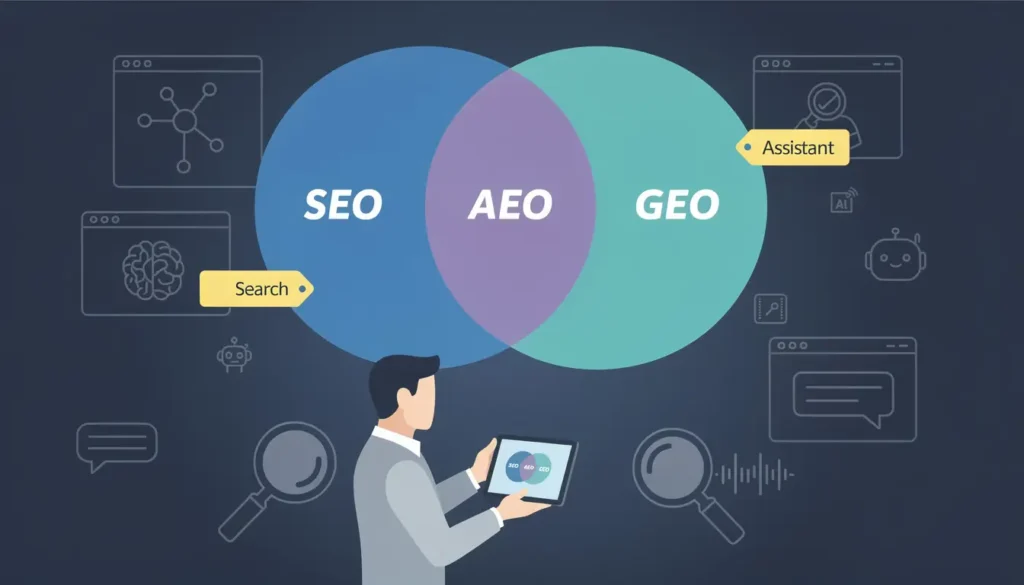
With the explosion of AI Search, the landscape has become more complicated. Let's clarify the differences between these three complementary approaches.
| I wait | SEO | AEO | GEO |
|---|---|---|---|
| Meaning | Search Engine Optimization | Answer Engine Optimization | Generative Engine Optimization |
| Objective | Rank in the SERPs | Be THE direct answer | Getting cited by generative AIs |
| Target | Google, Bing (organic) | Snippet, AI Overview, Voice | ChatGPT, Perplexity, Claude |
| Key metrics | Position, CTR, Traffic | Snippet wins, Zero-click visibility | AI Quotes, Brand Mentions |
| Content Focus | Keyword + intent | Direct answers 40-60 words | Authoritativeness + completeness |
| Ideal format | Optimized long-form | Q&A, lists, tables | Complete content + original data |
When to Use What
Use SEO when:
- Do you want direct organic traffic to your site?
- Your business depends on clicks (e-commerce, lead gen)
- The target keywords have a low zero-click rate
Use AEO when:
- Do you want brand awareness even without clicks?
- Target informational queries with featured snippets
- Optimized for voice search and voice assistants
Use GEO when:
- Do you want to be mentioned in ChatGPT/Perplexity replies?
- Your audience uses AI for complex searches
- Want to build authority in your industry?
The truth? The three strategies overlap and reinforce each other. Content optimized for AEO is often also excellent for GEO. And the SEO foundation remains essential: 96% of the links cited in the AI Overviews still come from the organic top 10.
Learn more about the differences in my guide on GEO – Generative Engine Optimization.
The Evolution: From Featured Snippets to AI Overviews
To understand AEO today, you need to know its history. It all started with a simple idea: answering users' questions directly.
The AEO Timeline
| Year | Event | Impact |
|---|---|---|
| 2014 | Google launches Featured Snippets | The “zero position” is born” |
| 2015 | The “People Also Ask” boxes are arriving” | Related questions visible |
| 2017 | Smart speaker explosion | Mainstream voice search |
| 2019 | BERT improves language understanding | Interpreted conversational queries |
| 2023 | Google announces SGE | AI generates synthesized responses |
| 2024 | SGE becomes “AI Overviews” | 200+ countries reached |
| 2025 | AI Overviews in the 60% query USA | AEO becomes a necessity |
The Turning Point: May 2024
When Google officially launched AI Overviews, the landscape changed forever. These aren't just snippets extracted from a page: they're summarized answers from multiple sources, generated by the Gemini AI.
The impact was immediate:
- 34.5% of CTR decline for pages in first position (SE Ranking)
- 13.34 sources cited on average for each AI Overview (double from 2024)
- 80% of the sources cited were NOT in the organic top 10 for that query
This last point is crucial: AEO opens up opportunities even for those who don't already dominate traditional SERPs.
AEO Numbers in 2025
The up-to-date data every marketer needs to know to guide their AEO strategy.
Zero-Click Search: The Current Scenario
| Metrics | Value | Source |
|---|---|---|
| Zero-click searches (total) | 58.5% | SparkToro 2025 |
| Zero-click on mobile | 77.2% | SparkToro 2025 |
| Zero-click on desktop | 46.5% | SparkToro 2025 |
| Zero-click with AI Overview | 83% | Data 2025 |
| Organic Clicks USA | 40.3% | SparkToro 2025 |
Featured Snippet: The Key Numbers
| Metrics | Value | Source |
|---|---|---|
| Searches with featured snippets | 12.29% | Ahrefs 2025 |
| Optimal response length | 40-60 words | Semrush/Moz |
| Paragraph format | 70% | Ahrefs |
| List format | 19% | Ahrefs |
| SERP with People Also Ask | 78% | Ahrefs |
AI Search Platforms: Market Share
| Platform | AI Traffic Quota | Users |
|---|---|---|
| ChatGPT | 77.97% | 800M weekly |
| Perplexity | 15.1% | 15M+ active users |
| Google Gemini | 6.4% | N/A |
| Claude | <1% | N/A |
How Answer Engines Work
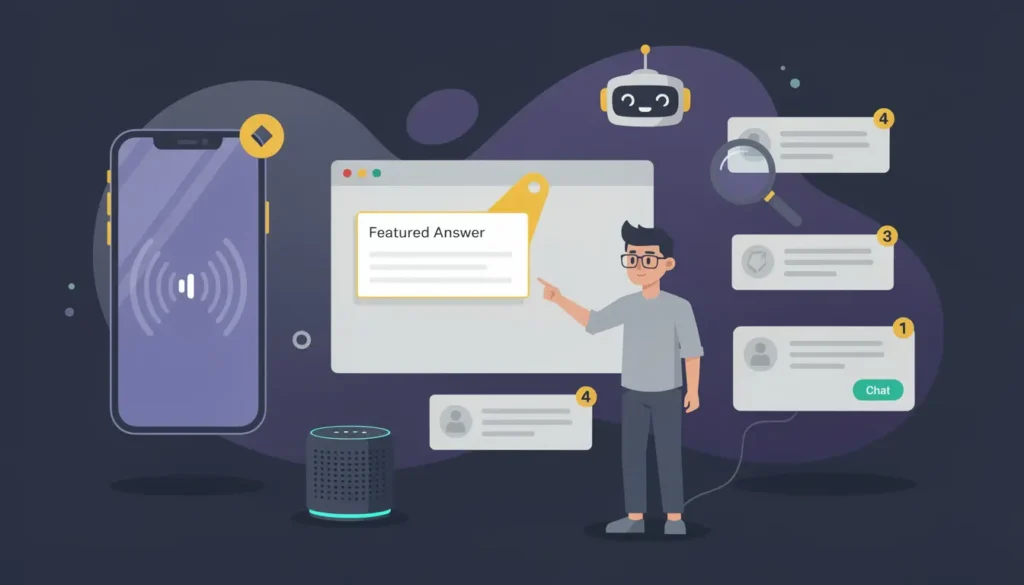
Each platform has its own way of selecting sources. Understanding these mechanisms is essential for optimization.
Google Featured Snippet
Featured snippets extract content from a single page to directly answer the query. Google displays them when it detects a clear question intent.
How Google selects the source:
- 99.58% of featured snippets comes from the organic top 10
- Position 1 = 30.9% chance of getting the snippet
- Position 2 = 23.5%, Position 3 = 15.9%
- Content that directly answers the question in the first 40-60 words
- Clear formatting (H2 with question, answer immediately below)
Types of Featured Snippets
| Type | Trigger Query | Ideal Format |
|---|---|---|
| Paragraph | “what is it”, “why”, “definition” | 40-60 words of direct response |
| List | “how to”, “the best”, “steps” | Ordered/bullet list max 8 elements |
| Table | “comparison”, “vs”, “prices” | Table 5 rows × 2-3 columns |
Google AI Overviews
Unlike featured snippets, AI Overviews they synthesize content from multiple sources (typically 3-8) using the Gemini model.
Source selection criteria:
- Domain Authority (EEAT)
- Specific thematic relevance
- Verifiable factual accuracy
- Structural clarity of content
- Presence of data and statistics with source
Interesting fact: Reddit is the most cited source in AI Overviews (21%) because it offers direct answers, real-world experiences, and frequently updated content.
ChatGPT Search
In Browse mode, ChatGPT searches the Bing index in real time, rewriting user queries into targeted searches.
How ChatGPT selects sources:
- Wikipedia dominates with the 7.8% of total quotes
- Prefers encyclopedic and structured content
- Evaluate visible author credentials
- Prefers clear Q&A formats
- Cite authoritative and verifiable sources
Perplexity AI
Perplexity uses a more selective and curated index, with a focus on accuracy and verifiability.
The three pillars of selection:
- Domain Authority: prefers consolidated and recognized sources
- Extractability: clear, well-structured, easily “quotable” content”
- Accuracy: specific data, statistics with sources, verifiable information
Voice Assistants (Siri, Alexa, Google Assistant)
Voice assistants have specific needs: short, clear, pronounceable responses.
| Assistant | Primary Source | Secondary Source |
|---|---|---|
| Google Assistant | Featured Snippets | Knowledge Graph |
| Alexa | Bing | Yelp (local) |
| Siri | Google/Bing | Apple Maps, Wolfram Alpha |
Voice search requirements:
- Answers from 29 words on average
- Loading time below 4.6 seconds
- Conversational language (how you speak, not how you write)
- Reading level 8th-9th grade
Practical Strategies for AEO
Let's move from theory to practice. Here are concrete strategies for optimizing your content for answer engines.
1. Structure Content for Extraction
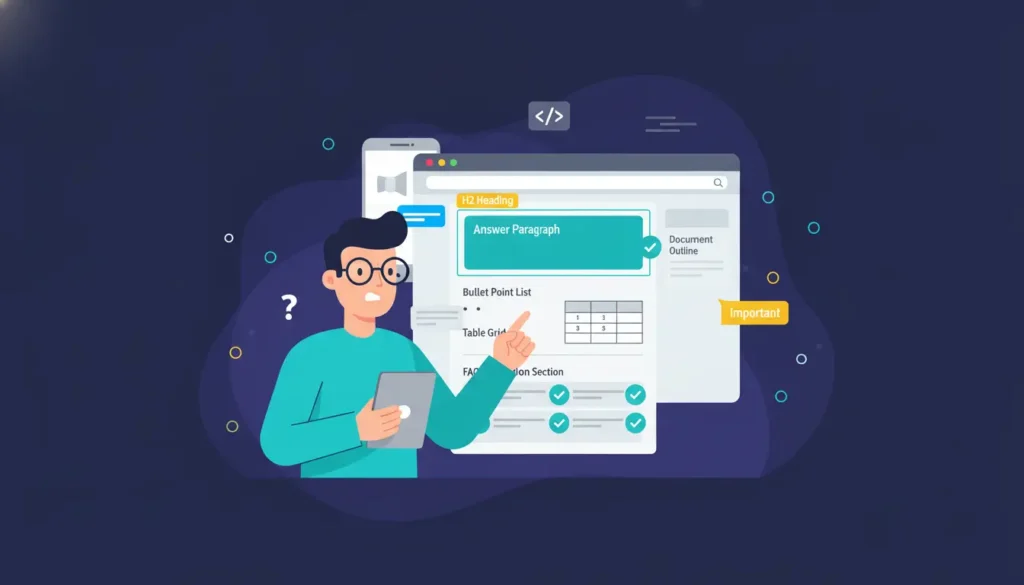
The AEO Golden Rule: answer first, explain later.
📐 Optimal Structure of a Section:
## [Question as H2] [Direct answer in 40-60 words - THIS will be extracted] [Expansion with details, examples, data] [Supporting list or table if relevant]
Optimal Lengths for Content Types
| Format | Ideal Length | When to Use It |
|---|---|---|
| Paragraph | 40-60 words | Definitions, explanations “what is/why” |
| List | Max 8 elements | How-to guides, best-of rankings“ |
| Table | 5 rows × 2-3 columns | Comparisons, technical specifications, prices |
| Step | 5-7 steps | Tutorials, procedures |
2. Optimize for Real-World Questions
The queries that trigger answer engines are almost always questions. Find the right ones with a good keyword research.
Question Types and Answer Format
| Query Type | Example | Snippet Format |
|---|---|---|
| “How” / “Come” | “How to Optimize for AEO” | List (46,91% of cases) |
| “What” / “What is” | “What is AEO?” | Paragraph |
| “Why” / “Perché” | “Why AEO is important” | Paragraph (99.94%) |
| “Best” / “Best” | “best AEO tools” | List |
| “vs” / “Comparison” | “AEO vs. SEO” | Table |
3. Implement Schema Markup
Schema markup is the technical foundation of AEO. It helps AI understand the structure of your content.
| Scheme | Use | Benefit |
|---|---|---|
| FAQ Page | FAQ Sections | Rich result with expandable questions |
| HowTo | Step-by-step guides | Rich result with steps |
| QAPage | Single Q&A pages | Clear identification of the answer |
| Speakable | Content for voice | Indicates text optimized for audio |
4. Optimize for Voice Search
Voice search requires a specific approach: natural language, concise responses, local content.
🎤 Voice Search Checklist:
- ☐ Use conversational language (how one speaks)
- ☐ Answer in 29 words or less for top answers
- ☐ Optimize for local queries (“near me”, “in [city]”)
- ☐ Ensures LCP under 2.5 seconds
- ☐ Implement LocalBusiness schema if applicable
- ☐ Write at an 8th-9th grade reading level
- ☐ Use questions like H2 and H3
5. Create Quotable Content“
To be cited by AI, your content must be authoritative and verifiable.
Elements of quotable content:
- Original data: proprietary research, surveys, case studies
- Statistics with source: always cite the year and source
- Clear definitions: in the first lines of each section
- Author Credentials: author box with experience and qualifications
- Frequent update: “last updated” date visible
In my case study with Woosa, content with original data got 340% more citations than generic content.
Complete AEO Optimization Checklist
Structure
- ☐ Direct answer in the first 40-60 words of each H2
- ☐ H2 and H3 formulated as real questions
- ☐ Lists max 8 elements, 5×3 tables
🔧 Technique
- ☐ FAQPage schema implemented
- ☐ HowTo for procedural guides
- ☐ LCP under 2.5 seconds
EEAT
- ☐ Author box with credentials
- ☐ Sources cited for each statistic
- ☐ “Last update” date visible
Essential Tools for AEO
The right tools make the difference between blind optimization and a data-driven strategy.
Tool for Finding Opportunities
| Tool | Function | Price |
|---|---|---|
| AlsoAsked | PAA Questions Visual Map | Free/Pro |
| AnswerThePublic | Autocomplete displayed | Free / $99/month |
| Semrush | Keyword Magic “Featured Snippet” filter | From $139.95/month |
| Ahrefs | Report snippet with advanced filters | From $99/month |
Tools for Monitoring AI Visibility
| Tool | What It Monitors | Price |
|---|---|---|
| Semrush AI Visibility | AI Overviews, AI Mode, ChatGPT | Included in the plans |
| Otterly.AI | ChatGPT, Perplexity, Google AIO | From $29/month |
| Conductor | Real-time citation tracking | Enterprise |
| Profound AI | 10+ LLM, 400M+ dataset prompt | Enterprise |
Essential Free Tools
- Google Search Console: monitor snippet appearances
- Schema Markup Validator: schema implementation check
- PageSpeed Insights: check out Core Web Vitals
- Rich Results Test: test rich snippets
Common Mistakes to Avoid
After analyzing hundreds of sites, these are the most common AEO errors.
The 7 Fatal Mistakes of AEO
1. Using the Wrong Format
Respond with a paragraph when a list is needed, or vice versa. Analyze existing featured snippets for your target keyword.
2. Bury the Answer
Start with long introductions before getting to the point. The answer should be within the first 40-60 words after the H2.
3. Ignore Schema Markup
Think of the schema as "optional." The FAQPage and HowTo schema are the bare minimum.
4. Forget Mobile and Speed
The 77% zero-click is on mobile. Mobile-first design and LCP under 2.5 seconds are a must.
5. Treat AEO like SEO
AEO requires a specific structure. The 80% of sources in AI Overviews is NOT in the organic top 10.
6. Keyword Stuffing
AI values semantic richness and natural language. Write for humans, structure for AI.
7. Abandon Traditional SEO
96% of links in AI Overview come from the organic top 10. SEO and AEO must coexist.
The Future of AEO

Where is Answer Engine Optimization going? Here are predictions based on current trends.
2026 Forecast
- Traditional searches drop 25% (Gartner): More and more users will use AI chatbots instead of Google
- AI Overviews in 40-50% Queries: expanding beyond informational queries
- Google Interface UnificationAI Mode, AI Overviews and Web Guides could merge
- Voice commerce at $100 billion: voice shopping will explode
- 157+ million US voice search users: continuous growth of assistants
How to Prepare
5 Actions to Prepare for the Future
- Treat AI like a new customer — AI agents will become primary consumers of branded content
- Measure beyond clicks — New metrics: citation frequency, brand mentions in AI responses
- Modular content — Answers at different levels: short (40 words), medium (200), complete (1000+)
- Diversify your traffic sources — Don't rely solely on Google: ChatGPT, Perplexity, YouTube, Reddit
- Invest in EEAT — AIs will increasingly only cite sources with proven authority
Conclusion
THE'’AEO It represents a paradigm shift: from competing for clicks to competing for citations. With 58.5% of searches ending without clicks and AI synthesizing responses from multiple sources, being "the answer" has become more important than being "the first result.".
The 3 key points to remember:
- Extraction structure: direct answer in the first 40-60 words, then expansion
- Schema markup is required: FAQPage, HowTo, Speakable are the minimum
- SEO + AEO togetherSEO foundation remains essential, AEO is layered on top
The good news? The Italian market is still underserved by AEO. Those who move now have a huge competitive advantage.
★★★★★
400+ projects completed • 9+ years of experience
🎯 Want to Dominate Answer Engines?
Complete AEO audit with featured snippet analysis, AI Overviews and voice search optimization
📧 info@adriangram.ch • Response guaranteed within 24 hours
FAQs
What is AEO in simple words?
AEO (Answer Engine Optimization) is the optimization of content to appear as a direct answer in AI, Google's featured snippets, and voice assistants. The goal is to be cited as a source, not just rank in the SERPs.
What is the difference between AEO and SEO?
SEO aims to drive clicks to your site through organic rankings. AEO aims to get your content pulled and cited as a direct response, even without clicks. SEO measures positions and traffic, AEO measures citations and visibility in answer engines.
How do you optimize for featured snippets?
To optimize for featured snippets: use H2s with the exact question, answer in the first 40-60 words, format in lists for "how to" queries, use tables for comparisons, implement FAQPage schema. 99,58% of snippets come from the top 10, so traditional SEO remains essential.
Does AEO replace SEO?
No, AEO doesn't replace SEO. 96% of the links cited in the AI Overviews come from the organic top 10. AEO is layered on top of a solid SEO foundation. Both are essential for a comprehensive visibility strategy in 2025-2026.
How long does it take to see results from AEO?
The first featured snippets can be obtained in 2-4 weeks if the content is already well-ranked. AI Overviews and ChatGPT citations typically require 2-3 months of consistent optimization. Voice search also requires local and technical optimization, which can take 3-6 months for measurable results.
What tools do you need to do AEO?
Essential tools for AEO include AlsoAsked or AnswerThePublic to find questions, Semrush or Ahrefs to monitor featured snippets, Otterly.AI or Semrush AI Visibility to track AI citations, and Surfer SEO to optimize content structure. Google Search Console is essential and free.